There is a strange imbalance in the support available to small business owners in Australia. At the very beginning, when you are starting a business, there is no shortage of help. Grants, government departments, the small business ombudsman’s website, local council resources, all readily available to anyone setting up shop. And at the very end, once a business is already in serious trouble, there is no shortage of information either. ASIC’s RG 217 guidance spells out the insolvency indicators in detail: here is what trouble looks like, here is what happens next.
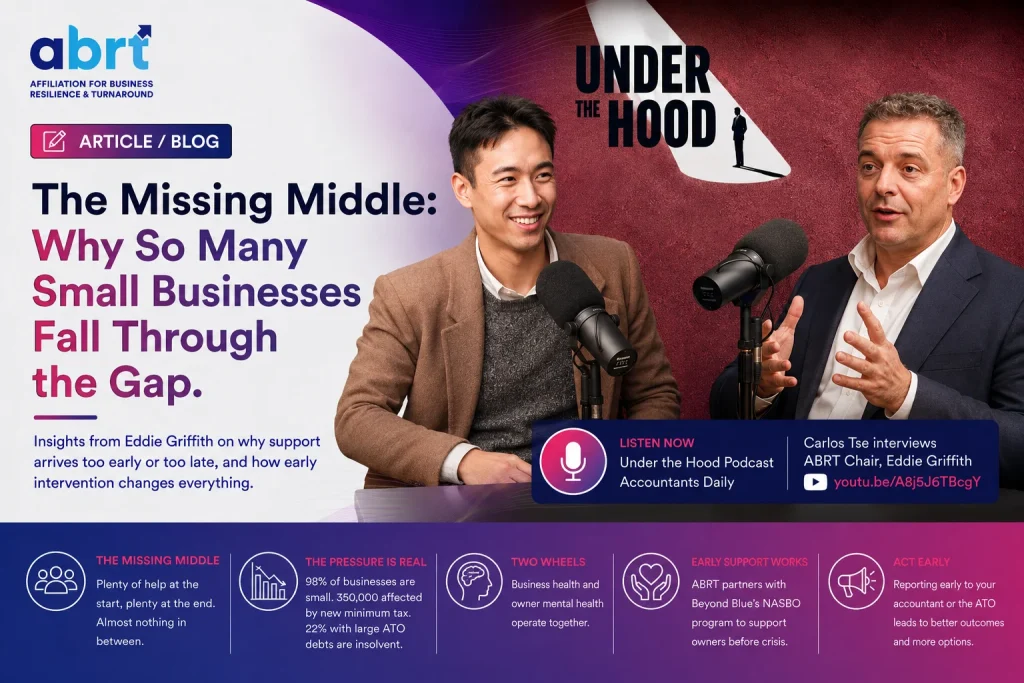
The problem, as our Chair Eddie Griffith explained on the Accountants Daily podcast Under the Hood, is what sits between those two points. Almost nothing. Griffith calls it the missing middle, and it is where far too many otherwise viable businesses fall through.
By the time those official insolvency indicators start showing up in a business’s books at year end, it is often already too late. An owner might bring their accounts to their accountant once a year, everything technically up to date, and the numbers already tell a story that has been building quietly for months. The support exists on paper. It just tends to arrive after the point where it could have changed the outcome.
The pressures making this gap more dangerous right now are real and current. Small businesses make up 98 per cent of all businesses in Australia. Treasury figures show 350,000 small businesses will be affected by the new 30 per cent minimum tax on discretionary trusts, adding real cost and time burden through restructuring on top of everything else. Separately, research shows nearly 22 per cent of businesses carrying ATO debts over $100,000 in the last year are currently insolvent. COSBOA’s Perspectives report found 77 per cent of rural businesses are experiencing anxiety and stress. This is not a small, isolated issue. It is widespread, and it is building.
Part of what drives the missing middle, Griffith explained, comes down to how stressed business owners actually behave. When an owner is under pressure, their instinct is not to sit down and address compliance. It is to focus entirely on operations, on the immediate, tangible problems in front of them, chasing cash flow, chasing the next sale, putting out fires. Compliance quietly slips down the list. Accountants and bookkeepers tend to think in the opposite direction, compliance first, fundamentals first. That mismatch means the people best placed to spot early warning signs are often the last people hearing from a business owner who is struggling.
This is where ABRT’s partnership with Beyond Blue’s NewAccess for Small Business Owners program, NASBO, comes in. ABRT focuses on the legal, practical, taxation and financial side of a business in distress, but as Griffith put it plainly, we are not clinicians. NASBO is a free, Treasury funded coaching program that helps business owners work through the behavioural and mental health side of financial stress, and it is genuinely recognised and promoted by the ATO itself. What ABRT has consistently found is that once a business owner engages with that support, their behaviour shifts. They start responding to lodgements. They start having the harder conversations about cash flow and forecasting. Some do not even need ABRT’s help after that. They come through the NASBO program and the business steadies itself.
That connection reflects something Griffith describes using a simple image, two wheels of a push bike. Business health and owner mental health operate in tandem. If one breaks, the other tends to follow. It sounds obvious once someone says it out loud, and yet, as Griffith noted, professionals steeped in numbers and warning indicators can miss the simplest intervention of all, picking up the phone and asking someone how they are actually doing.
None of this is about waiting for a crisis to be resolved from the outside. It is about catching problems while a business still has options, and reporting early, whether that is to an accountant, or directly to the ATO, genuinely changes how those conversations go. The system is set up to be far more receptive to a business owner who comes forward early than one who is discovered too late.
For every small business owner navigating a hard stretch right now, the message underneath all of this is simple. The middle does not have to stay missing. Support exists, it is just a matter of reaching for it before the numbers force the issue. Real resilience is not about pushing through alone until the crisis arrives. It is about recognising the pressure early enough to still have choices.
You can hear the full conversation between Carlos Tse and Eddie Griffith on the Accountants Daily podcast Under the Hood here: https://youtu.be/A8j5J6TBcgY
