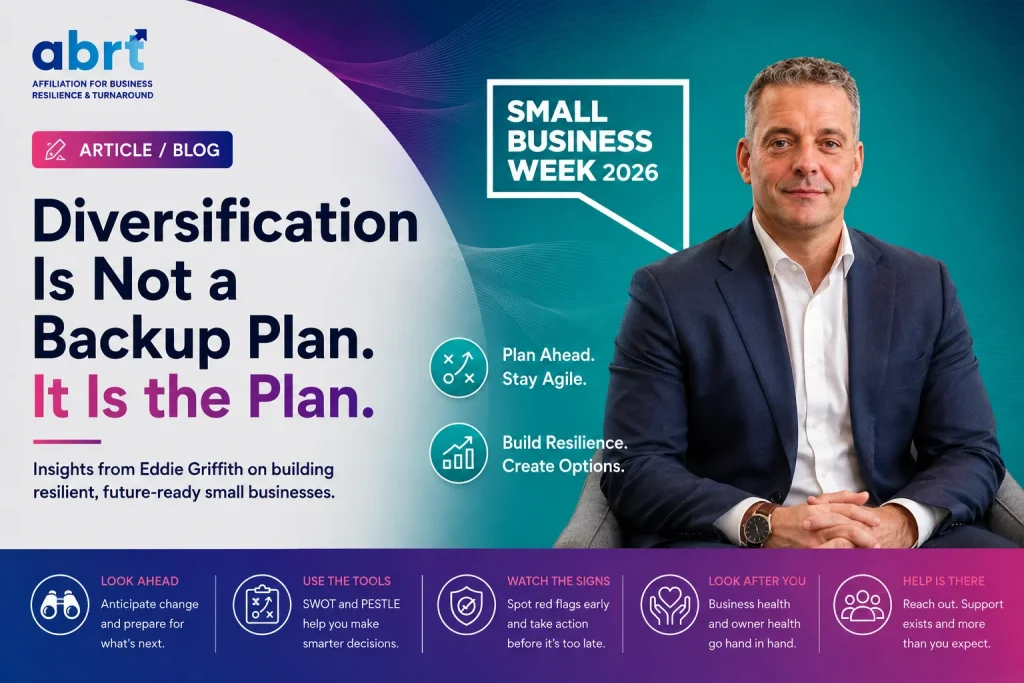
At DSD Small Business Week 2026, ABRT Chair Eddie Griffith made a point that runs against how a lot of business owners actually think about diversification. It is not something you reach for when things go wrong. It is, in his words, probably the single most critical factor to long term business success, full stop.
Diversification, plainly put, means reducing reliance on any one product, service or income stream. Owners often file it away mentally as a defensive move, something you consider once a business feels shaky. Griffith’s framing flips that. Diversification is not just a strategy for surviving difficult times, it is a roadmap for scaling successfully in a fast changing market. The strongest businesses do not wait for pressure to force the issue, they prepare for the worst case scenario well before it arrives.
The example he points to is one most people intuitively understand: rural and seasonal businesses. A business that depends heavily on rainfall does not simply hope for a good season, it rotates land and crops so it can adapt regardless of what the weather does. That same instinct, staying agile and adaptable rather than locked into one outcome, is exactly what diversification looks like in any business.
There is a sequencing point worth taking seriously here too. Diversification only really works once the fundamentals are locked in, financial forecasting, a clear read on your capabilities and resources, staffing in the right place. Only then does it make sense to start building strategic alliances and partnerships that extend what the business can do.
For owners wanting a practical starting point, Griffith recommends two tools that should sit inside a living strategic plan, reviewed regularly rather than written once and forgotten. The first is a SWOT analysis, looking honestly at your Strengths, Weaknesses, Opportunities and Threats. The second is a PESTLE analysis, scanning the Political, Economic, Social, Technological, Legal and Environmental pressures bearing on the business. Together, they give you a structured way to identify your core strengths, spot risks and market pressures early, explore where genuine diversification opportunities sit, and set a deliberate risk appetite, including whether your pricing is aggressive enough to actually support the business.
The underlying discipline here is time management. Staying vigilant does not mean working harder inside the business, it means carving out real time to work on the business plan itself.
Griffith also laid out a clear set of red flags every small business owner should recognise early, because by the time they compound, options narrow fast. Records starting to slip because you are too busy working in the business. Receipts not being collected, your bookkeeper chasing you, your accountant flagging concerns about cash flow. Using the business bank account as if it were a personal account. Realising the jobs you are quoting are not actually covering costs. A creeping tax debt. Or the moment you feel the pull to go online looking for a quick loan just to cover cash flow. Any one of these, on its own, is a signal worth acting on, not waiting out.
Griffith’s advice at that point is direct and twofold. Talk to your accountant, bookkeeper or broker straight away. And, just as importantly, talk to someone about your own mental health at the same time. He described business owner health and business health as operating like the two wheels of a bike, tied together, and if one wobbles, the other is rarely far behind. It is a point ABRT takes seriously enough to have built a partnership with Beyond Blue around it.
Perhaps the most useful reframe in the whole talk is how Griffith describes resilience itself. It is not a trait you either have or do not. It is a mindset that needs practice, something built over time by learning from setbacks and developing real strength from them, not something anyone is simply born with.
If there is one closing message worth carrying forward, it is this: help is genuinely there for the asking. Free tools and resources exist through accountants, brokers, bookkeepers, professional bodies, and local, state and federal government programs. Griffith’s own observation, backed by years working with struggling business owners, is that reaching out tends to be met with far more reciprocation than most owners expect.
You can watch Eddie Griffith’s full talk from DSD Small Business Week 2026 here: https://vimeo.com/1217511819/2312bb0f29
